Categories:
Corporate AI Training
How AI Is Disrupting Industries: Real-World Examples and ROI
October 14, 2026
Introduction
Artificial intelligence (AI) is changing how businesses operate, make decisions, serve customers, and compete in the marketplace. From helping doctors analyze medical information to enabling manufacturers to predict equipment failures, AI is creating new ways to solve problems and improve efficiency.
The industries impacted by AI are not limited to technology companies. Healthcare, finance, education, manufacturing, retail, and digital marketing are all exploring how AI can support their operations. Some organizations use AI to automate repetitive tasks, while others apply it to research, forecasting, personalization, and decision-making.
However, adopting AI does not automatically guarantee better business results. Organizations need to identify the right use cases, evaluate implementation costs, manage risks, and measure outcomes to understand whether their investment is worthwhile.
In this guide, we explore how AI is disrupting industries through practical examples, the benefits and challenges of AI adoption, and how businesses can measure return on investment (ROI) before expanding their AI initiatives.
What Does It Mean When AI Disrupts an Industry?
AI disrupts an industry when it changes how organizations perform work, deliver products or services, interact with customers, or compete with other businesses. This disruption can involve automating existing processes, improving decisions with data, creating new products, or introducing services that were previously difficult to deliver.
For example, a retailer might use AI to forecast product demand, while a manufacturer could analyze equipment data to identify signs of potential failure. A marketing team might use AI to summarize customer feedback and develop campaign ideas more efficiently.
AI disruption does not always mean replacing an entire business process or eliminating human involvement. In many cases, AI supports employees by handling routine work, organizing information, or identifying patterns that people can review and act upon.
How AI Is Changing Traditional Business Models
- Automation: AI can perform or support repetitive tasks that previously required manual effort.
- Data-driven decisions: AI systems can help identify patterns, trends, and anomalies in large datasets.
- Personalization: Businesses can tailor recommendations, communications, and experiences to individual needs.
- Predictive capabilities: AI can help estimate likely outcomes using historical information and relevant inputs.
- New products and services: Generative AI and other AI technologies enable organizations to explore new ways of delivering value.
- Workforce transformation: Employees may spend less time on routine tasks and more time on analysis, problem-solving, and customer relationships.
The impact varies by industry, business size, available data, and the complexity of the work involved. Successful adoption begins with a clear business problem rather than the technology alone. Understanding how AI models are trained can also help businesses make more informed decisions about which tools are suitable for their needs.
1. How AI Is Disrupting Healthcare
Healthcare is one of the industries where AI can support information-intensive work, clinical research, administrative processes, and patient services. Medical professionals must often review large amounts of information, coordinate care, and make decisions under strict safety and privacy requirements.
AI can assist with selected tasks, but its use in healthcare requires appropriate validation, professional oversight, and compliance with applicable regulations.
Real-World AI Applications in Healthcare
- Medical image analysis: AI systems can help trained professionals examine medical images and identify patterns that may require further review.
- Administrative automation: AI can assist with organizing documentation, summarizing records, and processing routine administrative information.
- Patient communication: AI-powered assistants can answer general questions, provide approved information, and help patients navigate healthcare services.
- Research support: AI tools can help researchers organize scientific literature, analyze datasets, and explore potential research directions.
- Operational planning: Healthcare organizations can use analytical models to support staffing, scheduling, and resource planning.
How AI Can Create Business Value in Healthcare
Healthcare organizations can evaluate AI projects by examining whether they reduce administrative workload, improve scheduling, shorten selected processing times, or help staff use resources more effectively.
For example, a healthcare provider could pilot an AI-assisted documentation system for a specific department. Before expanding the system, the organization should compare documentation time, correction rates, staff feedback, operating costs, and compliance requirements against the previous process.
AI-generated recommendations should not replace qualified clinical judgment. Patient safety, data protection, and the reliability of the system must remain central to implementation decisions.
2. How AI Is Disrupting the Finance Industry
Financial institutions process transactions, assess risk, monitor unusual activity, and manage large volumes of customer and operational data. AI can support these activities by identifying patterns, prioritizing cases, and helping employees review information more efficiently.
Real-World AI Applications in Finance
- Fraud detection: AI models can identify unusual transaction patterns and flag activity for further investigation.
- Customer support: AI assistants can answer routine banking questions and guide customers toward relevant services.
- Risk analysis: AI can help analysts examine financial information and identify factors that may require closer review.
- Document processing: AI tools can extract information from documents and assist with organizing applications or financial records.
- Compliance support: AI can help teams prioritize alerts and review records, subject to regulatory and operational controls.
How AI Can Create Business Value in Finance
Financial organizations can measure AI's contribution by examining the cost of reviewing cases, the number of alerts requiring manual investigation, processing times, error rates, and the quality of risk decisions.
For example, a financial institution could test an AI system that prioritizes potentially suspicious transactions for human review. The pilot should measure whether the system helps investigators focus on relevant cases without creating an unacceptable number of false alerts.
Financial decisions can have significant consequences for customers. Businesses must assess model accuracy, fairness, explainability, privacy, security, and regulatory obligations before relying on AI outputs.
3. How AI Is Disrupting Education and Workforce Training
Education and professional training are changing as AI tools make it possible to provide more interactive learning support, assist instructors, and organize educational information. These applications can support both learners and the professionals responsible for designing and delivering training.
Real-World AI Applications in Education
- Personalized learning support: AI assistants can explain concepts, generate practice questions, and help learners review difficult material.
- Content development: Instructors can use AI to create draft lesson plans, learning activities, and assessment questions for review.
- Administrative assistance: AI can help organize course information, summarize feedback, and support routine communications.
- Learning analytics: Educational organizations can analyze relevant learning data to identify patterns and areas where additional support may be useful.
- Career development: AI tools can help learners explore career paths, identify skills to develop, and practice professional tasks.
How AI Can Create Business Value in Education
Training providers can evaluate AI initiatives by measuring course preparation time, learner engagement, completion rates, learner satisfaction, and the time instructors spend on routine administrative work.
For example, a training organization could introduce an AI learning assistant for a single course. It could compare learner feedback, support requests, instructor workload, and learning outcomes before and after the pilot.
AI-generated learning materials should be checked for factual accuracy, accessibility, relevance, and alignment with course objectives. Learner privacy and academic integrity also require attention.
Workforce development organizations can use AI to support learning, but effective training still requires clear objectives, appropriate instructional design, and meaningful human guidance. Businesses planning workforce development can also explore the AI skills gap and identify where employees may need additional training.
4. How AI Is Disrupting Manufacturing
Manufacturing businesses must manage equipment performance, product quality, inventory, supply chains, and production schedules. AI can help manufacturers analyze operational data and identify opportunities to improve reliability and efficiency.
Real-World AI Applications in Manufacturing
- Predictive maintenance: AI models can analyze equipment data to identify patterns associated with potential failures.
- Quality inspection: Computer vision systems can help detect visible defects or inconsistencies in products.
- Production planning: AI can support scheduling decisions by analyzing demand, capacity, and operational constraints.
- Supply chain forecasting: AI tools can help estimate demand and identify possible disruptions using available data.
- Energy management: Analytical systems can help identify unusual consumption patterns and opportunities to improve energy efficiency.
How AI Can Create Business Value in Manufacturing
Manufacturers can measure AI ROI by tracking equipment downtime, maintenance costs, defect rates, production throughput, energy consumption, and waste.
For example, a manufacturer could pilot predictive maintenance on a specific machine or production line. The organization should compare maintenance expenses and unplanned downtime against a suitable baseline while accounting for implementation and operating costs.
The quality of the data is important. Incomplete sensor readings, changing equipment conditions, or poorly calibrated models can lead to unreliable predictions. AI should complement established maintenance procedures rather than replace essential safety controls.
5. How AI Is Disrupting Retail and E-Commerce
Retailers must understand customer preferences, maintain appropriate inventory, manage product information, and deliver relevant shopping experiences. AI can help businesses analyze purchasing patterns and support decisions across merchandising, customer service, and supply chain operations.
Real-World AI Applications in Retail
- Product recommendations: AI systems can suggest products based on relevant browsing behavior, purchase history, and product information.
- Demand forecasting: AI can help estimate future demand and inform inventory planning.
- Customer support: AI assistants can answer common questions about products, orders, and store policies.
- Inventory management: AI can help identify stock patterns and highlight items that may need replenishment.
- Product content: Generative AI can assist with drafting product descriptions, categorizing information, and preparing marketing copy.
- Customer sentiment analysis: AI can help summarize reviews and feedback to identify recurring customer concerns.
How AI Can Create Business Value in Retail
Retailers can evaluate AI initiatives by tracking conversion rates, average order value, inventory turnover, stock availability, customer support costs, and return rates.
For example, an online retailer could test AI-generated product recommendations on a limited group of pages. The business should compare the results with a suitable control group and measure incremental sales or profit rather than assuming that every recommendation creates additional revenue.
Retailers should also consider customer privacy, recommendation quality, inaccurate product descriptions, and the risk of generating misleading information. Businesses improving digital customer journeys may also find practical ideas in WFI's guide to AI tools for designing user experiences.
6. How AI Is Disrupting Digital Marketing
Digital marketing involves research, content creation, audience segmentation, search optimization, advertising, campaign measurement, and customer engagement. AI can assist marketing teams with many of these activities, but its value depends on how well the tools support the overall marketing strategy.
Real-World AI Applications in Digital Marketing
- Content development: Generative AI can help marketers brainstorm topics, create outlines, and draft content for human review.
- SEO research: AI tools can assist with organizing search queries, analyzing content themes, and identifying potential optimization opportunities.
- Audience analysis: AI can help identify patterns in customer behavior and group audiences using appropriate data.
- Campaign optimization: AI-enabled advertising platforms can support bidding, targeting, and campaign delivery decisions.
- Personalization: Marketing systems can tailor recommendations and communications using relevant customer signals and consented data.
- Performance reporting: AI tools can help summarize campaign data and highlight changes that require further investigation.
How AI Can Create Business Value in Marketing
Marketing teams can measure AI ROI through content production costs, campaign conversion rates, customer acquisition costs, qualified leads, revenue contribution, and time saved on routine work.
For example, a marketing team could use an AI assistant to prepare first drafts of campaign content. The team should measure total production time, editing effort, content quality, and campaign performance rather than evaluating success solely by the amount of content produced.
AI-generated content still requires human review for accuracy, originality, brand consistency, and usefulness to the intended audience. Search optimization should focus on meeting user needs rather than publishing large volumes of low-value material. Marketers should also avoid common SEO mistakes that can cost businesses traffic when using AI to support content and search optimization.
For more information, read WFI's guide on building a digital marketing strategy.
7. How AI Is Disrupting Software Development and IT
Software development teams are exploring AI tools that assist with coding, debugging, testing, documentation, and technical research. These tools can support developers at different stages of the software development lifecycle.
Real-World AI Applications in Software Development
- Code assistance: AI tools can suggest code, explain unfamiliar functions, and help developers explore possible solutions.
- Testing support: AI can help draft test cases, analyze failures, and identify areas that may need additional testing.
- Debugging: Developers can use AI to investigate error messages and examine potential causes of defects.
- Documentation: AI can help draft technical explanations, summaries, and documentation for review.
- IT support: AI assistants can help employees troubleshoot common issues and locate relevant technical guidance.
How AI Can Create Business Value in Software Development
Technology teams can assess AI tools by measuring development cycle time, code review effort, defect rates, test coverage, maintenance costs, and developer feedback.
For example, a software team could pilot an AI coding assistant for a defined set of tasks. The evaluation should include the time required to review and correct generated code, the quality of the resulting software, and any additional security or maintenance risks.
Generated code can contain errors, insecure patterns, or unsuitable dependencies. Developers remain responsible for testing, reviewing, and approving code before it is used in production. For a closer look at this shift, read WFI's article on AI-powered software development.
Learn more about the skills involved in AI-focused development through WFI's AI software engineer bootcamp curriculum.
8. How AI Is Disrupting Transportation and Logistics
Transportation and logistics businesses coordinate deliveries, routes, warehouses, inventory, and changing customer demand. AI can support these operations by analyzing data and helping teams make better-informed planning decisions.
Real-World AI Applications in Transportation and Logistics
- Route planning: AI-assisted systems can help evaluate routes using traffic, delivery windows, and operational constraints.
- Demand forecasting: AI can help estimate shipping volumes and support resource planning.
- Warehouse operations: AI can support inventory tracking, order prioritization, and selected warehouse processes.
- Fleet maintenance: Equipment and vehicle data can help identify maintenance needs.
- Delivery monitoring: AI tools can help identify delays and flag shipments that may require intervention.
How AI Can Create Business Value in Logistics
Logistics organizations can measure AI performance using delivery times, fuel consumption, route efficiency, missed delivery windows, warehouse processing time, and maintenance costs.
For example, a delivery business could test AI-assisted route planning in one service area. It should compare the results with existing routing methods while accounting for traffic variation, delivery complexity, driver requirements, and software costs.
AI recommendations should be monitored when unexpected events occur. Human operators may need to intervene when safety, weather, customer requirements, or other constraints change.
Which Industries Are Most Affected by AI?
The industries most affected by AI depend on how much of their work involves data, repeatable processes, prediction, content generation, or complex information analysis. The level of disruption also depends on regulation, infrastructure, available data, and the consequences of making a mistake.
| Industry | Potential AI applications | Useful performance measures |
|---|---|---|
| Healthcare | Documentation support, image analysis, scheduling, research | Processing time, administrative cost, error rates, staff workload |
| Finance | Fraud detection, document processing, customer support, risk analysis | Review time, false alerts, processing costs, decision quality |
| Education | Learning support, content development, feedback analysis | Preparation time, learner satisfaction, completion rates |
| Manufacturing | Predictive maintenance, quality inspection, production planning | Downtime, defect rates, waste, maintenance costs |
| Retail | Recommendations, demand forecasting, inventory planning | Conversion rate, stock availability, inventory turnover, profit |
| Digital marketing | Content assistance, audience analysis, campaign optimization | Acquisition cost, qualified leads, conversions, production time |
| Software development | Coding support, testing, debugging, documentation | Cycle time, defects, review effort, maintenance costs |
| Transportation and logistics | Route planning, demand forecasting, fleet maintenance | Delivery times, fuel use, route efficiency, operating costs |
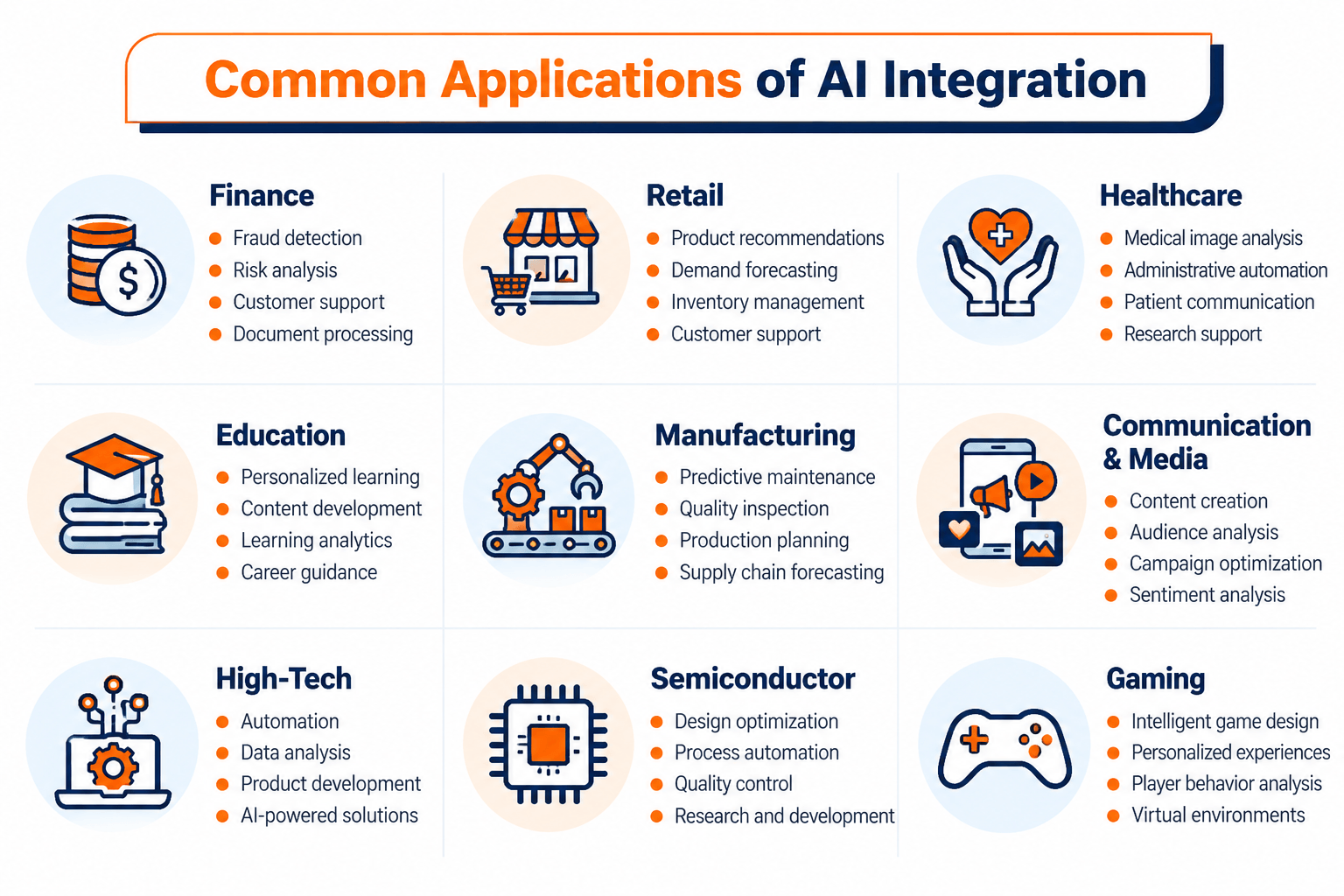
This comparison is a starting point rather than a universal ranking. A business should select an AI use case based on its own needs, available data, risks, and ability to measure results.
What Is AI Return on Investment (ROI)?
AI return on investment measures the financial value generated by an AI initiative compared with the costs of implementing and operating it. Depending on the project, businesses may also track non-financial outcomes such as improved service quality, reduced risk, employee satisfaction, or faster access to information.
AI ROI should account for more than subscription fees. Organizations may need to consider integration, data preparation, employee training, security, monitoring, maintenance, and the cost of reviewing AI-generated work.
How to Calculate AI ROI
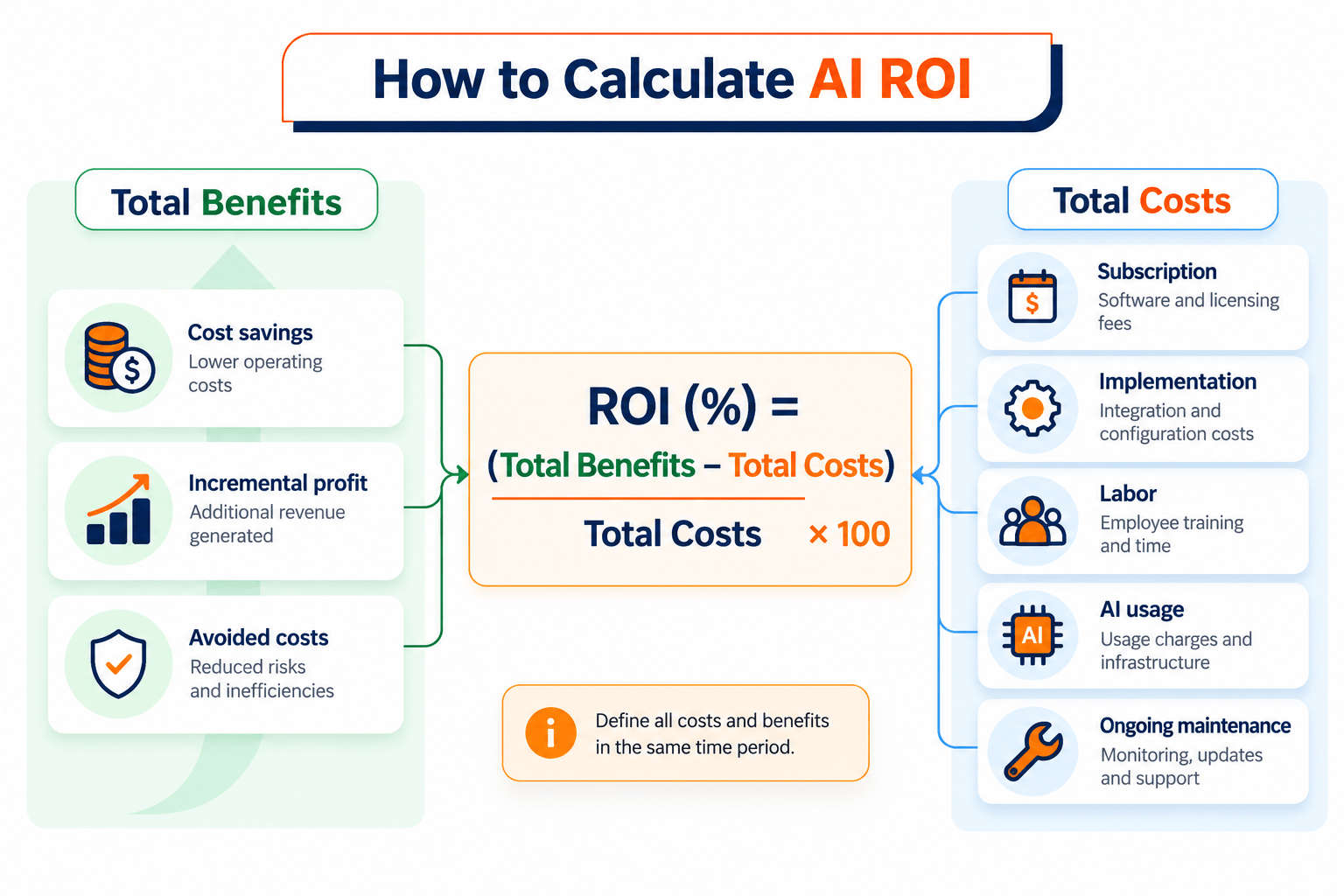
A basic ROI calculation is:
ROI (%) = (Net Benefits ÷ Total Investment Cost) × 100
Net benefits represent the measured financial benefits after subtracting the relevant costs from the value generated. For a straightforward evaluation, businesses can calculate net benefits by subtracting total project costs from total financial benefits over the same period.
For example, suppose a business spends $10,000 implementing an AI-assisted workflow and estimates $15,000 in measurable financial benefits during the evaluation period. If those figures include all relevant costs and benefits, the net benefit is $5,000 and the ROI is 50%.
This is an illustrative example, not a forecast of typical AI returns. Actual results depend on the use case, implementation quality, operating costs, and whether the benefits can be attributed to the AI project.
Which Costs Should Businesses Include?
- Software and licensing: Subscription fees, usage charges, and other platform costs.
- Implementation: Integration, configuration, development, and deployment expenses.
- Data preparation: Data cleaning, access management, storage, and quality improvements.
- Training: Employee training, change management, and time spent learning new workflows.
- Monitoring and maintenance: Testing, model evaluation, system updates, and incident handling.
- Human review: Time required to check outputs, correct errors, and approve sensitive actions.
Which Benefits Should Businesses Measure?
- Time savings: Reduction in the time required to complete a task.
- Cost reduction: Lower operating costs or reduced spending on specific activities.
- Revenue contribution: Additional revenue that can reasonably be linked to the AI initiative.
- Quality improvements: Fewer errors, less rework, or more consistent output.
- Capacity gains: Ability to handle more work without a proportional increase in resources.
- Risk reduction: Measurable reductions in selected risks, where the value can be reasonably estimated.
Businesses should avoid counting the same benefit more than once. For example, time saved should not automatically be treated as direct financial savings unless it results in a measurable cost reduction or creates other demonstrable value.
How Businesses Can Measure AI ROI Successfully
A structured evaluation helps organizations determine whether an AI project delivers meaningful results and whether it should be expanded.
Step 1: Define a Specific Business Problem
Start with a problem that can be described clearly, such as lengthy document processing, high support workload, inconsistent reporting, or avoidable production downtime.
A focused problem makes it easier to choose a suitable AI solution and determine whether it improves the existing process.
Step 2: Establish a Baseline
Record current performance before introducing AI. Depending on the task, the baseline may include completion time, labor costs, error rates, customer satisfaction, or production delays.
Without a baseline, it can be difficult to determine whether a change resulted from AI adoption or from other operational factors. Strong measurement also depends on reliable data, so businesses can learn more about how generative AI is changing data analysis and the role of data-informed decision-making.
Step 3: Choose Relevant KPIs
Define a small set of key performance indicators (KPIs) linked to the business objective. A customer support project might measure resolution time and customer satisfaction, while a manufacturing project might measure downtime and defect rates.
Step 4: Run a Controlled Pilot
Test the solution on a limited workflow, department, or group of users. Where practical, compare its results with a control group or the previous process under similar conditions.
A pilot allows the organization to discover errors, integration issues, training needs, and unexpected costs before expanding the project.
Step 5: Calculate Total Costs and Benefits
Include direct and indirect implementation costs, ongoing operating expenses, human review, and the financial value of measurable improvements. Use the same evaluation period for both costs and benefits.
Step 6: Evaluate Risks and Quality
Financial returns are not the only consideration. Review accuracy, privacy, security, compliance, fairness, and the consequences of system failures. A project with apparent financial benefits may still be unsuitable if its risks cannot be controlled.
Step 7: Decide Whether to Expand
Expand an AI initiative only when the evidence supports it. If results are weak, identify whether the issue involves the use case, data quality, workflow design, training, or the technology itself.
Some projects may deliver value through better service or reduced risk rather than immediate financial savings. These outcomes should be measured separately and evaluated against the organization's goals.
Challenges Businesses Face When Adopting AI
Although AI offers opportunities across industries, implementation can introduce technical, operational, and organizational challenges. Businesses should address these issues early rather than treating them as afterthoughts.
Data Quality and Availability
AI systems depend on suitable information. Incomplete, inconsistent, outdated, or biased data can reduce output quality. Organizations should assess whether the required data is accurate, accessible, relevant, and appropriately managed.
Privacy and Security
AI tools may process customer information, employee records, financial data, or confidential business documents. Businesses should review data handling policies, access permissions, retention practices, vendor terms, and applicable legal requirements.
Accuracy and Reliability
AI-generated content and predictions can be wrong. Organizations should establish appropriate review procedures, test systems using realistic examples, and define how employees should handle uncertain or incorrect outputs.
Integration with Existing Systems
AI tools may need to connect with databases, internal applications, or established workflows. Integration can introduce additional costs and technical complexity. A pilot can help identify compatibility issues before broader deployment.
Employee Skills and Change Management
Employees need to understand how to use AI tools, evaluate their outputs, and recognize situations requiring human judgment. Clear guidance and practical training can help teams adopt AI responsibly. Organizations can review the skills companies expect from AI data analysts to understand some of the capabilities relevant to data-informed work.
Organizations exploring AI workforce development can learn more about the skills companies expect from AI data analysts and the capabilities needed for data-informed work.
Unclear Business Objectives
Adopting AI simply because it is available can result in unnecessary spending and limited value. Businesses should define the problem, expected outcome, success measures, and acceptable risks before selecting a tool.
Best Practices for Adopting AI Across Industries
Businesses can improve their chances of success by following a structured approach to AI implementation.
- Start with a clear use case: Select a problem with a defined objective and measurable outcome.
- Assess feasibility: Review data availability, technical requirements, costs, and integration needs.
- Choose the right level of automation: Use AI assistance where human review is central and consider more extensive automation only when the workflow and risks justify it.
- Protect sensitive information: Apply appropriate access controls and review privacy and security requirements.
- Keep humans involved where needed: Require qualified review for decisions that affect safety, finances, legal rights, or other high-impact outcomes.
- Train employees: Teach teams how to use AI effectively, verify outputs, and report issues.
- Monitor performance: Track KPIs, errors, operating costs, and user feedback after deployment.
- Review results regularly: Update the implementation when business needs, data, systems, or risks change.
Responsible AI adoption is an ongoing process. Regular evaluation helps businesses determine whether a solution continues to deliver value as conditions change.
Frequently Asked Questions
1. Which industries are most affected by AI?
Healthcare, finance, education, manufacturing, retail, marketing, software development, and logistics all have potential AI applications. The actual impact varies according to the tasks involved, the availability of suitable data, regulation, and the organization's ability to implement AI effectively.
2. What are some real-world examples of AI disrupting industries?
Examples include AI-assisted medical image analysis, transaction fraud detection, personalized learning support, predictive maintenance in manufacturing, product recommendations in retail, AI-assisted marketing content, coding assistance, and logistics route planning. These applications can support existing workflows, but their effectiveness depends on the implementation and appropriate oversight.
3. How can businesses calculate AI ROI?
Businesses can calculate AI ROI by comparing the net financial benefits of a project with its total investment cost. They should include software, implementation, training, data preparation, maintenance, and human review, then compare the costs with measurable savings or incremental financial benefits over the same period.
4. Does AI always reduce business costs?
No. AI can reduce certain costs or improve productivity, but it can also introduce licensing fees, integration expenses, training requirements, and additional review work. Businesses should measure the total cost of ownership and compare it with verified benefits before expanding a project.
5. Can small businesses benefit from AI?
Yes. Small businesses may use AI assistants for drafting content, summarizing documents, answering routine questions, organizing information, or supporting customer service. The best starting point is a specific, manageable task with clear success measures and appropriate data protection.
6. What are the main risks of using AI in business?
Common risks include inaccurate outputs, privacy and security issues, biased results, integration difficulties, unexpected costs, and overreliance on automated decisions. Organizations should assess risks before deployment and establish testing, monitoring, and human oversight procedures.
7. How can employees prepare for AI-driven changes in their industries?
Employees can develop AI literacy, data analysis, critical thinking, problem-solving, and communication skills. They should learn how to use relevant AI tools, verify outputs, and apply professional judgment to their work. Technical roles may also require skills in programming, automation, data management, and systems integration.
8. Should businesses automate an entire workflow with AI?
Not necessarily. Businesses should evaluate each step based on its complexity, risk, and need for human judgment. It may be appropriate to automate routine, well-defined tasks while retaining human approval for sensitive decisions, exceptions, or actions with significant consequences.
Conclusion
AI is disrupting industries by changing how organizations analyze information, automate tasks, support customers, and make operational decisions. From healthcare and finance to education, manufacturing, retail, marketing, software development, and logistics, businesses can explore AI applications suited to their specific needs.
However, the value of AI should be demonstrated rather than assumed. Organizations need to consider data quality, implementation costs, employee training, security, accuracy, and the potential consequences of errors. A clear business objective and a controlled pilot can help determine whether a solution delivers meaningful results.
Measuring AI ROI requires comparing the total cost of implementation and operation with the financial benefits that can reasonably be attributed to the project. Businesses should also consider quality, customer experience, risk reduction, and employee productivity where these outcomes are relevant.
By choosing suitable use cases, training employees, maintaining appropriate human oversight, and monitoring performance, organizations can adopt AI more responsibly and make better-informed decisions about where to invest next.
October 14, 2026
Related Posts