Categories:
Generative AI
Generative AI vs. Traditional AI: Key Differences, Uses, and Examples
October 13, 2026
Introduction
Artificial intelligence (AI) is changing how businesses operate, how professionals solve problems, and how organizations make decisions. From recommending products to generating marketing content and assisting software developers, AI now supports a wide range of everyday tasks.
However, not every AI system works in the same way. Traditional AI is commonly designed to analyze information, recognize patterns, make predictions, or follow defined rules. Generative AI, on the other hand, can create new content, including text, images, code, audio, and other outputs based on patterns learned from training data.
Understanding generative AI vs. traditional AI helps businesses choose the right technology for their needs and helps professionals identify the skills they need to work effectively with AI tools.
In this guide, we explain how both approaches work, their key differences, practical applications, benefits, limitations, and career opportunities.
What Is Traditional AI?
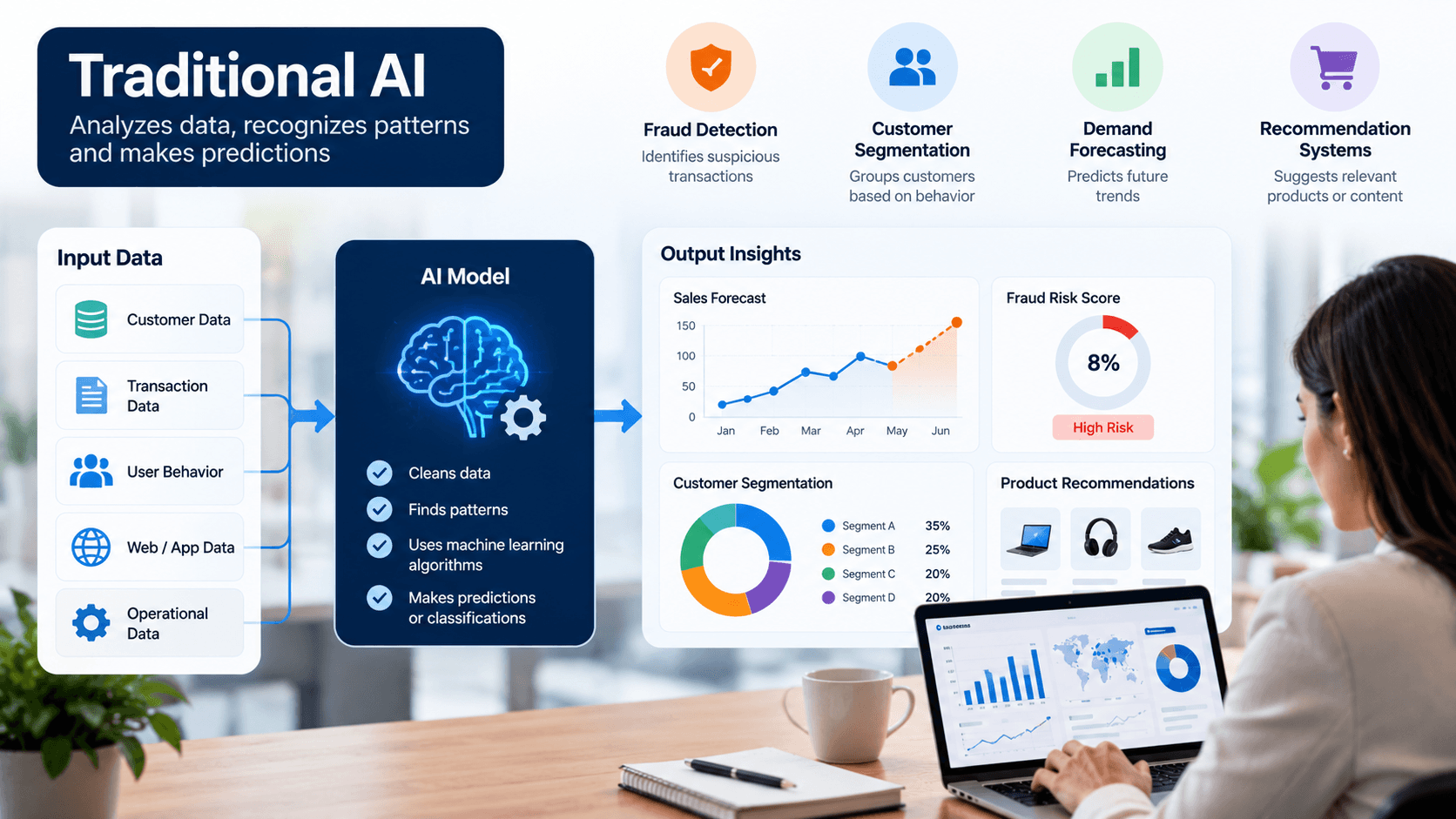
Traditional AI refers to AI systems built primarily to analyze data, classify information, recognize patterns, predict outcomes, or make decisions. These systems typically perform specific tasks using rules, statistical methods, machine learning models, or other established techniques.
For example, a bank may use a traditional AI model to identify potentially fraudulent transactions. The model analyzes transaction characteristics and estimates whether an activity is suspicious.
How Does Traditional AI Work?
Traditional AI systems generally follow a process that includes:
- Data collection: Gathering relevant historical or real-time information.
- Data preparation: Cleaning and organizing the information for analysis.
- Model training or rule definition: Developing a model or defining rules for a specific task.
- Analysis and prediction: Applying the model to new information to classify, score, or predict an outcome.
- Evaluation and improvement: Measuring performance and updating the system when necessary.
The exact process depends on the system. Rule-based systems may rely on explicitly defined conditions, while machine learning systems learn patterns from examples.
Examples of Traditional AI
- Fraud detection: Identifying transactions that may require further investigation.
- Recommendation systems: Suggesting products or content based on user behavior and preferences.
- Demand forecasting: Estimating future sales or inventory requirements from historical data.
- Spam filtering: Classifying emails as potentially unwanted or legitimate.
- Predictive maintenance: Identifying equipment patterns that may indicate a risk of failure.
- Customer segmentation: Grouping customers based on shared characteristics or behavior.
What Is Generative AI?
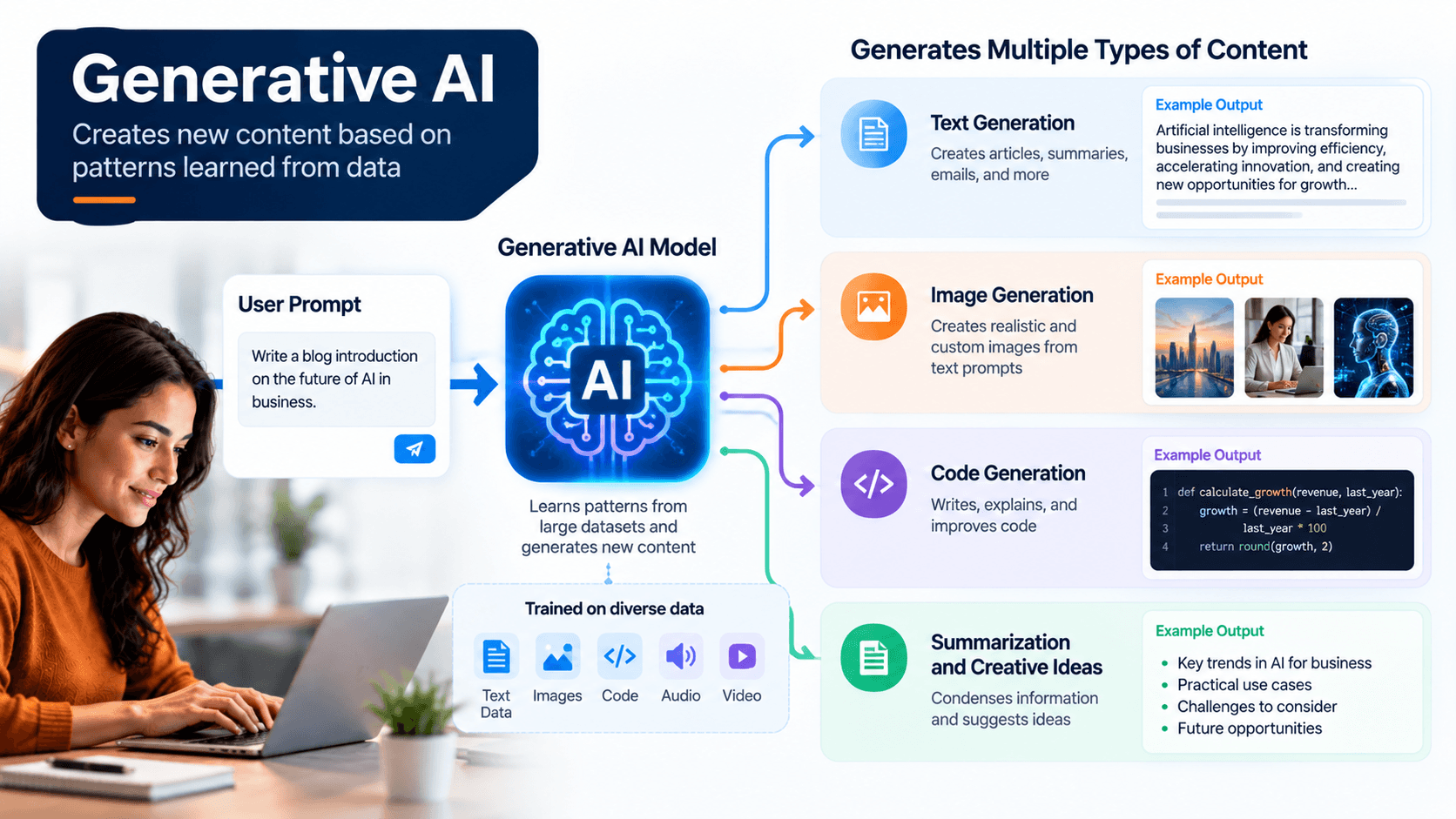
Generative AI is a category of artificial intelligence that creates new content based on patterns learned from training data. Depending on the model, it can generate written text, computer code, images, audio, video, and other forms of content.
Generative AI systems include large language models and image-generation models. Many modern systems use deep learning architectures, such as transformers or diffusion models, to produce outputs in response to a prompt or other input.
For example, a marketing professional can ask a generative AI tool to draft a product description, suggest campaign ideas, or summarize a report. A developer can use a coding assistant to explain a function or suggest an implementation.
How Does Generative AI Work?
Generative AI models learn statistical patterns and relationships from large collections of training data. When a user provides a prompt, the model uses its learned representations to generate an output that fits the request. To understand this process in more detail, read our guide to understanding AI model training, which explains how AI models learn from data.
A typical workflow includes:
- Training: The model learns patterns and relationships from training data.
- Prompting: A user supplies an instruction, question, example, or other input.
- Generation: The model produces a response or content based on the prompt and its learned patterns.
- Review and refinement: The user checks the output for accuracy, relevance, quality, and suitability.
Generated content is not automatically correct. Models can produce inaccurate statements, biased results, or content that needs substantial editing. Human review remains important, especially for high-stakes decisions and professional work.
Examples of Generative AI
- Text generation: Drafting emails, articles, summaries, and reports.
- Code assistance: Suggesting code, explaining programming concepts, and helping identify potential errors.
- Image generation: Creating illustrations, concept art, and visual drafts from descriptions.
- Document summarization: Condensing lengthy documents into shorter explanations.
- Conversational assistants: Responding to questions and helping users complete tasks.
- Creative ideation: Producing initial ideas for campaigns, presentations, and product concepts.
Generative AI vs. Traditional AI: Key Differences
The main difference between generative AI and traditional AI is their typical purpose. Traditional AI often focuses on analyzing information and predicting or classifying outcomes, while generative AI focuses on producing new content. These categories can overlap, and the right approach depends on the problem being solved.
| Comparison | Traditional AI | Generative AI |
|---|---|---|
| Primary purpose | Analyze data, classify information, or predict outcomes | Generate new content or responses |
| Typical output | Scores, classifications, forecasts, recommendations, or decisions | Text, code, images, audio, or other generated content |
| Common techniques | Rule-based systems, statistical models, and predictive machine learning | Generative models, including large language models and diffusion models |
| Input | Structured or unstructured data, depending on the task | Prompts, examples, text, images, or other supported inputs |
| Typical applications | Fraud detection, forecasting, classification, and recommendations | Content creation, code assistance, summarization, and image generation |
| Evaluation | Often measured through predictive accuracy, error rates, or business outcomes | Often evaluated for relevance, factual accuracy, quality, safety, and usefulness |
| Main limitations | Data quality, model bias, changing patterns, and task-specific limitations | Hallucinations, inconsistent outputs, bias, privacy concerns, and review requirements |
Traditional AI vs. Generative AI: Real-World Applications
1. Marketing and Content Creation
Traditional AI can analyze customer behavior, estimate campaign performance, segment audiences, and recommend when or where to display advertisements. Generative AI can help marketers draft campaign copy, brainstorm content ideas, and create initial versions of social media posts.
Used together, these technologies can help teams analyze campaign performance and develop content more efficiently. Marketers still need to review claims, maintain brand consistency, and ensure that content meets audience and business requirements.
2. Software Development
Traditional AI can support software testing, anomaly detection, predictive maintenance, and the identification of patterns in code or system behavior. Generative AI coding assistants can suggest code, explain unfamiliar functions, create test drafts, and help developers explore alternative solutions. Developers who want to build these skills can explore our AI software engineer bootcamp curriculum for a closer look at relevant training topics.
Developers should review generated code for correctness, security vulnerabilities, performance, licensing considerations, and compatibility with the existing application.
3. Data Analytics
Traditional AI and machine learning are useful for forecasting, classification, anomaly detection, and identifying patterns in datasets. Generative AI can help analysts draft SQL queries, explain analytical results, summarize reports, and translate technical findings into plain language. AI is also changing design workflows, from generating interface concepts to supporting design tasks. Learn more in our guide to how UX/UI designers use AI tools.
Analysts should validate calculations, check the underlying data, and independently verify important conclusions rather than treating generated explanations as proof.
4. Customer Service
Traditional AI can classify support tickets, route requests, identify common issues, and predict which cases may require additional attention. Generative AI can draft conversational responses, summarize customer interactions, and help support teams locate relevant information.
Businesses should protect customer data and provide appropriate human oversight for sensitive complaints, financial matters, and other high-impact situations.
5. Business Operations
Traditional AI can help organizations forecast demand, detect unusual activity, and optimize resource allocation. Generative AI can summarize internal documentation, draft reports, and help employees find answers across approved knowledge sources.
The best approach depends on whether the main need is reliable analysis, content generation, or a combination of both.
Benefits of Traditional AI
- Consistent task performance: Well-designed systems can repeatedly apply the same rules or analytical process.
- Data-driven predictions: Machine learning models can identify patterns that support forecasting and risk assessment.
- Automated classification: Systems can sort large volumes of information into useful categories.
- Operational efficiency: Automated analysis can reduce the manual effort involved in repetitive tasks.
- Measurable performance: Many models can be evaluated using clearly defined metrics, such as precision, recall, and prediction error.
Benefits of Generative AI
- Faster content development: AI can create initial drafts, summaries, and ideas for human review.
- Flexible assistance: A single model may support several related tasks through different prompts.
- Developer productivity: Coding assistants can help explain code and propose implementations.
- Information accessibility: Natural-language interfaces can make complex information easier to explore.
- Creative exploration: Teams can quickly compare alternative concepts, outlines, and approaches.
Limitations and Risks of Both Approaches
Although both approaches can create business value, neither guarantees accurate or unbiased results.
Traditional AI Limitations
- Models can perform poorly when new data differs significantly from training data.
- Biased or incomplete datasets can produce unfair or unreliable outcomes.
- Some systems require specialized data preparation, monitoring, and maintenance.
- Predictive results may be difficult to interpret, depending on the model and application.
Generative AI Limitations
- Models can produce plausible-sounding but incorrect information, commonly called hallucinations.
- Outputs can vary between prompts and may require several rounds of editing.
- Generated content may reproduce bias or create copyright, confidentiality, and privacy concerns.
- Model usage can involve infrastructure costs, latency, and restrictions on sensitive data.
- Human review is necessary when factual accuracy, originality, security, or accountability matters.
Organizations should define clear policies for data handling, output verification, security, and human approval before deploying AI in important workflows.
Can Traditional AI and Generative AI Work Together?
Yes. Traditional AI and generative AI can complement one another in a single business process. For example, a customer support platform might use a classification model to identify the type and urgency of a request, then use a generative model to draft a response based on approved support documentation.
Similarly, a business could use a forecasting model to estimate future demand and generative AI to explain the forecast in a readable report. The forecasting model provides the estimate, while the generative model helps communicate the result.
These workflows still need suitable data access, integration, validation, monitoring, and human oversight. Combining models does not automatically make a system more accurate.
Which Should Your Business Choose?
The right choice depends on your objectives, available data, risk tolerance, budget, and how the results will be used.
- Choose traditional AI when: You need classification, forecasting, anomaly detection, recommendations, or measurable predictions from data.
- Choose generative AI when: You need to draft content, summarize documents, assist with coding, or create new text or visual material.
- Consider both when: A workflow requires analytical predictions as well as natural-language explanations or generated content.
Before implementation, define success metrics, test the system on representative data, evaluate potential risks, and compare the expected benefits with implementation and operating costs.
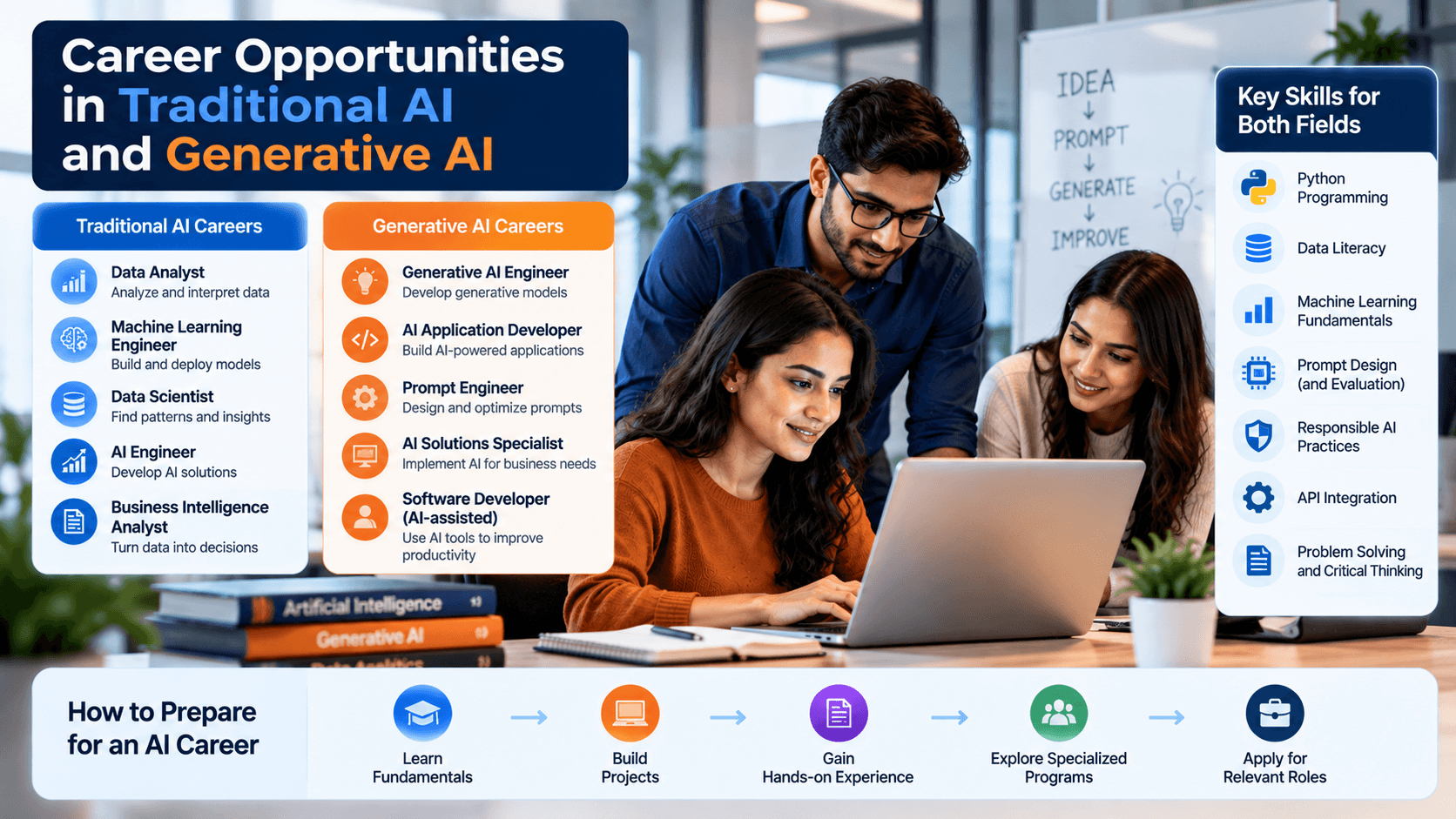
Career Opportunities in Traditional AI and Generative AI
Both areas create opportunities for professionals with technical, analytical, and problem-solving skills. The specific requirements vary by role and employer. To explore how AI is changing professional responsibilities, read our article on whether AI will replace professionals and how workers can prepare for changing skill requirements.
Traditional AI Career Paths
- Data analyst
- Machine learning engineer
- Data scientist
- AI engineer
- Business intelligence analyst
Relevant skills may include statistics, data preparation, Python, SQL, machine learning fundamentals, model evaluation, and data visualization. If you are considering a data-focused career, explore our guide on what an AI data analyst actually does to learn more about the role and its responsibilities.
Generative AI Career Paths
- Generative AI engineer
- AI application developer
- Machine learning engineer working with generative models
- AI solutions specialist
- Software developer using AI-assisted workflows
Useful skills may include Python, API integration, prompt design, model evaluation, retrieval-augmented generation (RAG), data privacy, and secure software development. Advanced roles may also require knowledge of model architecture and deployment.
How to Prepare for an AI Career
Start with programming fundamentals, data literacy, and an understanding of how machine learning systems work. Build small projects that solve practical problems, document your results, and learn how to evaluate model performance and limitations. For a more specific view of employer expectations, read our guide to the skills companies expect from AI data analysts.
For generative AI, experiment with approved tools and build applications that use reliable data sources, validation, and human review. For predictive AI, practice preparing datasets, training or evaluating models, and explaining results clearly.
Structured training can help learners develop these skills. Explore relevant WorkForce Institute programs in AI, software engineering, data analytics, or UI/UX design to identify a learning path that matches your career goals.
Frequently Asked Questions
1. What is the main difference between generative AI and traditional AI?
Traditional AI is commonly used to analyze data, classify information, or predict outcomes. Generative AI is designed to create new content, such as text, images, code, or audio. Some systems combine both capabilities.
2. Is ChatGPT generative AI or traditional AI?
ChatGPT is a generative AI assistant. It uses generative models to produce responses and can support tasks such as writing, summarization, explanation, and coding assistance. Its outputs should still be checked for accuracy.
3. Is machine learning the same as generative AI?
No. Machine learning is a broader field in which systems learn patterns from data. Generative AI is a category of AI that generates new content and often uses machine learning, particularly deep learning, to do so.
4. Is generative AI better than traditional AI?
Neither is universally better. Traditional AI may be more appropriate for a defined prediction or classification task, while generative AI may be better suited to creating content or assisting with natural-language tasks. The use case determines the right approach.
5. Can generative AI make predictions?
Generative AI can produce forecasts or estimates in some applications, but its outputs are not automatically reliable statistical predictions. For tasks requiring measurable predictive performance, organizations should evaluate suitable predictive models and validate the results.
6. Will generative AI replace traditional AI?
Generative AI is unlikely to make traditional AI unnecessary. Organizations still need systems for forecasting, classification, optimization, and anomaly detection. Generative AI may complement these systems in workflows that also require content creation or explanation.
7. What skills are needed to work with generative AI?
Useful skills include programming, prompt design, data literacy, model evaluation, API integration, and responsible AI practices. Requirements depend on whether the role focuses on using AI tools, building applications, or developing models.
Conclusion
Understanding generative AI vs. traditional AI helps professionals and businesses select the right technology for a specific problem. Traditional AI is commonly used to analyze data, classify information, and make predictions, while generative AI creates content and supports tasks such as writing, coding, and summarization.
Rather than viewing them as competing technologies, organizations should consider how the two approaches can complement each other. By defining clear objectives, validating outputs, protecting data, and maintaining human oversight, businesses can use AI more responsibly and effectively.
If you want to build skills for an evolving technology landscape, explore relevant WorkForce Institute learning programs and identify the AI, data, or software engineering skills that best fit your career goals.
October 13, 2026
Related Posts