How to Become an AI Analyst: Skills, Career Path, and Opportunities
October 15, 2026
Artificial intelligence is changing how businesses analyze information, understand customers, automate processes, and make decisions. As organizations increasingly use AI-powered tools, professionals who can interpret data, evaluate AI-generated insights, and turn findings into practical recommendations are becoming increasingly valuable.
If you enjoy working with data, solving problems, and exploring new technologies, becoming an AI analyst could be a career path worth considering. This role combines analytical thinking, technical knowledge, and business understanding to help organizations make informed decisions.
In this guide, you'll discover what an AI analyst does, which skills and tools you need, how to build practical experience, and what career opportunities you can explore.
What Is an AI Analyst?
An AI analyst is a professional who uses data analysis, artificial intelligence tools, and analytical methods to help organizations understand information and solve business problems.
Depending on the organization, an AI analyst may analyze datasets, evaluate AI-generated results, identify patterns, monitor AI-supported processes, and recommend ways to improve business performance. Some positions focus primarily on data analytics, while others require knowledge of machine learning, AI implementation, or model evaluation.
The main goal is to connect data and AI capabilities with real business needs. AI analysts help stakeholders understand what the information reveals, identify potential opportunities, and make decisions based on evidence.
What Does an AI Analyst Do?
The responsibilities of an AI analyst vary according to the company, industry, and position. However, several activities are common across many AI-related analytical roles.
1. Analyze Data and Identify Patterns
AI analysts examine datasets to identify trends, relationships, anomalies, and opportunities. They use analytical methods and visualization tools to make complex information easier to understand.
For example, an analyst working for an online retailer might examine purchasing behavior to identify customer preferences and improve product recommendations.
2. Use AI Tools to Support Analysis
AI-powered tools can help professionals summarize information, explore datasets, generate ideas, and automate repetitive analytical tasks. An AI analyst evaluates where these tools are useful and checks their outputs before relying on them.
3. Evaluate AI-Generated Results
AI systems can generate predictions, summaries, classifications, and recommendations. Analysts help determine whether these outputs are accurate, relevant, and suitable for the intended purpose.
This may involve validating source data, comparing results, identifying inconsistencies, and documenting limitations.
4. Create Reports and Visualizations
AI analysts communicate their findings through reports, charts, dashboards, and presentations. Clear reporting helps business teams understand trends and decide what actions to take.
5. Collaborate With Business and Technical Teams
AI analysts may work with data analysts, data scientists, software engineers, project managers, and business stakeholders. They help translate business questions into analytical tasks and explain technical findings in accessible language.
6. Monitor Data Quality and AI Performance
Some roles involve checking data quality, investigating unexpected results, and monitoring AI-supported processes. Analysts may recommend improvements when results are inconsistent, unreliable, or misaligned with business objectives.
AI Analyst vs. Data Analyst: What's the Difference?
AI analysts and data analysts share several responsibilities, but their areas of emphasis may differ.
| Comparison | Data Analyst | AI Analyst |
|---|---|---|
| Primary focus | Understanding data and business performance | Using data and AI capabilities to support analysis and decisions |
| Common tasks | Data cleaning, reporting, and identifying trends | Data analysis, AI-assisted workflows, and evaluating AI outputs |
| Tools | Spreadsheets, SQL, and visualization platforms | Analytics tools plus relevant AI tools and platforms |
| Technical requirements | Depend on the position | Depend on the position; some roles require programming or machine learning knowledge |
| Typical outcomes | Reports, dashboards, and business insights | Analytical findings, AI-related evaluations, and recommendations |
These differences are not universal. Some organizations use the AI analyst title for work similar to traditional data analysis, while others expect experience with machine learning systems or AI implementation. Always review the actual job responsibilities rather than relying on the title alone.
Essential Skills for an AI Analyst
Becoming an AI analyst does not necessarily require mastering every AI technology. Start with the fundamentals and develop additional skills based on the roles you want to pursue.
1. Data Analysis and Interpretation
Learn how to organize, clean, examine, and interpret datasets. You should be able to identify patterns, compare results, recognize data-quality problems, and draw evidence-based conclusions.
2. Statistics and Analytical Thinking
Basic statistics help you interpret data responsibly. Focus on averages, distributions, probability, correlation, variability, and the difference between correlation and causation.
Analytical thinking is equally important because it helps you ask meaningful questions, test assumptions, and distinguish useful findings from misleading patterns.
3. SQL and Spreadsheet Skills
SQL is commonly used to retrieve and analyze information stored in databases. Spreadsheet applications such as Microsoft Excel and Google Sheets are useful for calculations, data organization, and quick analysis.
These skills provide a practical foundation for many entry-level analytical positions.
4. Python Fundamentals
Python can support data cleaning, visualization, automation, and more advanced analysis. Depending on your target role, useful libraries may include pandas, NumPy, and Matplotlib.
Not every AI analyst position requires advanced programming. Review relevant job descriptions to decide how deeply you need to develop this skill.
5. Artificial Intelligence and Machine Learning Fundamentals
Understand the basic concepts behind artificial intelligence, machine learning, generative AI, training data, model predictions, and evaluation. You should know what AI systems can do, where they can fail, and why their outputs require appropriate validation.
Start with WFI's Understanding AI Model Training: A Beginner's Guide to explore how AI models learn from data.
6. Data Visualization and Communication
Learn how to present analytical findings through clear charts, dashboards, and concise explanations. Your goal should be to help stakeholders understand what the data means and how it relates to their business objectives.
7. Critical Thinking and Problem-Solving
AI-generated answers can be incomplete, biased, or inaccurate. Analysts must question assumptions, verify important claims, identify limitations, and recommend practical next steps.
8. Business and Industry Knowledge
Understanding the industry you work in helps you interpret findings in context. An analyst working in finance may need different knowledge from someone analyzing marketing campaigns, retail operations, or healthcare data.
Tools AI Analysts Should Learn
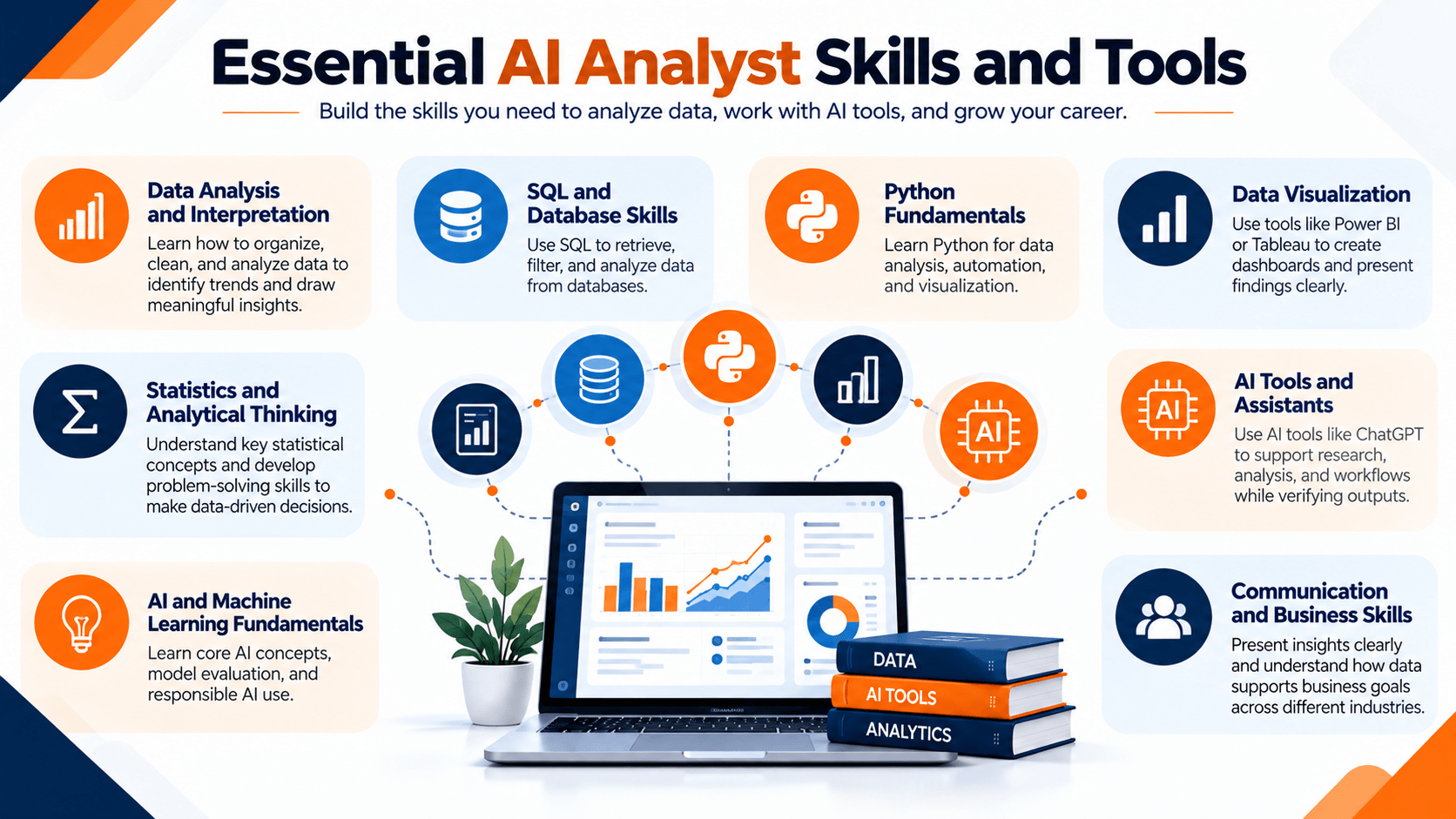
The tools you need depend on your responsibilities and level of technical expertise. Consider developing familiarity with these categories.
| Tool category | Examples | Purpose |
|---|---|---|
| Spreadsheets | Microsoft Excel, Google Sheets | Organize data and perform calculations |
| Database querying | SQL | Retrieve and analyze database information |
| Programming | Python | Clean datasets, automate tasks, and perform analysis |
| Data visualization | Power BI, Tableau | Create dashboards and communicate findings |
| AI assistants | ChatGPT and other suitable AI assistants | Support research, analysis, and workflows |
| Machine learning | Relevant machine learning libraries and platforms | Explore and evaluate machine learning workflows when required |
You do not need to learn every tool simultaneously. Begin with spreadsheets, SQL, and data interpretation. Then add Python, visualization platforms, and AI-specific tools according to your career goals.
Always follow relevant privacy and security policies when using AI tools with business information.
How to Become an AI Analyst: A Step-by-Step Roadmap
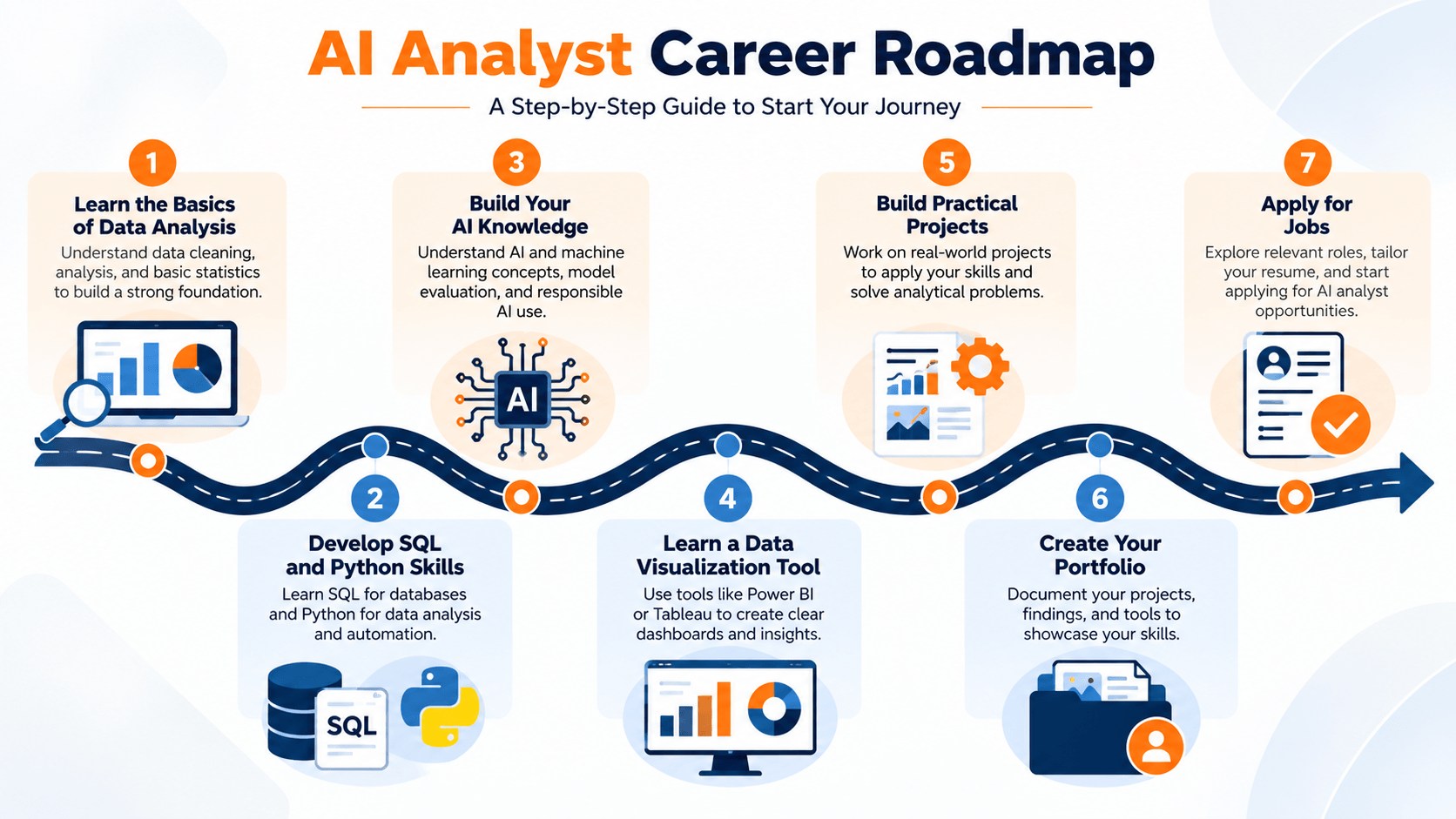
If you are starting from scratch, follow these steps to develop the knowledge and practical experience needed to pursue AI-related analytical roles.
Step 1: Learn the Fundamentals of Data Analysis
Begin with spreadsheets, data cleaning, basic statistics, and analytical thinking. Practice examining datasets and explaining what the results indicate.
Your objective is to understand how to turn raw information into a clear, evidence-based conclusion.
Step 2: Develop SQL and Python Skills
Learn SQL to retrieve and filter data from databases. Then develop Python skills for working with datasets and automating repetitive analytical tasks.
Practice solving realistic problems, such as identifying sales trends, comparing customer segments, or investigating unusual changes in performance.
Step 3: Build Your AI Knowledge
Study core AI and machine learning concepts, including training data, model predictions, model evaluation, generative AI, and responsible AI use.
Experiment with AI tools to understand how they can support analysis, but validate their outputs against reliable evidence.
Step 4: Learn a Data Visualization Tool
Choose a visualization platform such as Power BI or Tableau. Practice turning analytical findings into dashboards and charts that communicate a clear message.
Step 5: Build Practical Projects
Develop a small portfolio that demonstrates your ability to solve analytical problems. Potential projects include:
- Analyzing retail sales trends and creating a dashboard.
- Exploring customer feedback using AI-assisted text analysis.
- Evaluating the accuracy and limitations of AI-generated summaries.
- Comparing business performance across different time periods.
- Preparing a report that connects data findings with practical recommendations.
Use public or synthetic datasets, document your methodology, and explain the limitations of your findings. Never include confidential employer or client information in a public portfolio.
Step 6: Document Your Portfolio
For each project, describe the problem, dataset, tools, analytical process, key findings, and recommendations. Include screenshots or visualizations where appropriate.
Employers need to understand not only which tools you used but also how you approached the problem and evaluated your results.
Step 7: Review Job Descriptions and Apply
Search for positions such as AI analyst, junior data analyst, business intelligence analyst, data analytics associate, and AI operations analyst.
These titles are not interchangeable, so compare job descriptions to identify the skills most frequently requested for the roles you want. Tailor your résumé to highlight relevant projects, technical abilities, and outcomes supported by reliable evidence.
Do You Need a Degree to Become an AI Analyst?
Educational requirements vary by employer and position. Some organizations prefer degrees in data science, computer science, statistics, mathematics, business analytics, or related fields. Others may consider candidates with relevant practical experience, technical skills, certifications, and strong portfolios.
If you do not have a directly related degree, focus on building demonstrable skills and projects that match the responsibilities of your target positions.
A course or certification can provide structure for your learning, but it does not guarantee employment. Employers may also evaluate your problem-solving ability, communication skills, and understanding of data quality and responsible AI use.
AI Analyst Career Opportunities
AI-related analytical skills can be relevant across multiple industries. The opportunities available to you will depend on your experience, technical capabilities, and individual employer requirements.
Business and Operations
Organizations may use analysts to evaluate operational performance, identify inefficiencies, and assess AI-supported workflows.
Marketing and Customer Analytics
Analysts can study campaign performance, customer behavior, feedback, and segmentation to support marketing decisions. Professionals interested in this area can also explore WFI's digital marketing career roadmap to understand a related career path.
Finance and Risk Analysis
Some positions involve examining financial data, identifying unusual patterns, or evaluating analytical outputs used in risk-related workflows. These roles may require specialized financial knowledge and additional qualifications.
Healthcare Analytics
Healthcare organizations may use analytical professionals to examine operational or administrative data. Work involving clinical information can require specialized training, strict privacy controls, and regulatory awareness.
Technology and AI Operations
Technology companies may recruit analysts to evaluate AI outputs, monitor data quality, support AI implementation, or communicate analytical findings to product and engineering teams.
As you gain experience, you may explore related careers such as senior data analyst, business intelligence analyst, analytics consultant, or specialized AI and machine learning roles. Career progression depends on your skills and the requirements of each position.
Challenges AI Analysts Should Understand
AI analysis can provide useful insights, but it also presents practical challenges that professionals must understand.
- Data quality: Incomplete, inconsistent, or outdated information can undermine results.
- AI inaccuracies: AI-generated content and predictions can be incorrect or misleading.
- Bias and fairness: Data and analytical methods can produce unfair or unrepresentative outcomes.
- Privacy and security: Sensitive information must be handled according to applicable policies and laws.
- Changing tools: AI platforms and analytical workflows continue to evolve.
- Communication: Findings must be explained accurately without overstating what the data proves.
Strong AI analysts understand these limitations and communicate uncertainty rather than presenting every result as definitive.
How AI Analyst Training Can Support Your Career
Structured learning can help you build foundational knowledge, practice relevant tools, and organize your learning journey. The right training should align with the skills required for your intended role and give you opportunities to apply concepts through practical work.
Explore WFI's Generative AI Data Analyst program to learn more about relevant AI and data analytics training opportunities.
You can also review WFI's AI Software Engineer Bootcamp Curriculum to explore related AI learning topics. Software engineering and AI analyst roles have different responsibilities, so choose training based on your particular career goals.
Frequently Asked Questions
What does an AI analyst do?
An AI analyst uses data analysis and AI-related tools to identify patterns, evaluate outputs, prepare reports, and help organizations make informed decisions. Responsibilities vary by employer.
How long does it take to become an AI analyst?
The time required depends on your starting skills, study schedule, and target role. Someone with existing data analysis experience may need less preparation than a complete beginner. Focus on building demonstrable skills rather than relying on a fixed timeline.
Is coding required for an AI analyst?
Some positions require Python, SQL, or other technical skills, while others focus more on analytics, reporting, and AI-assisted workflows. Review job descriptions to determine the technical requirements of your preferred roles.
Can beginners become AI analysts?
Beginners can work toward entry-level analytical roles by learning data fundamentals, developing relevant technical skills, and building practical projects. Available opportunities depend on employer requirements and the strength of their preparation.
What is the difference between an AI analyst and an AI engineer?
An AI analyst generally focuses on analyzing information, evaluating outputs, and communicating insights. An AI engineer typically develops, integrates, or maintains AI-powered systems. Responsibilities can overlap, but the roles usually have different technical emphases.
Which tools should an aspiring AI analyst learn first?
Start with spreadsheets, SQL, data interpretation, and basic statistics. Add a visualization tool and Python, then develop familiarity with AI and machine learning concepts based on your target job requirements.
Is an AI analyst career suitable for nontechnical professionals?
It can be a possible career transition for professionals willing to develop analytical and technical skills. The most suitable starting point depends on existing experience, industry knowledge, and the requirements of available positions.
Conclusion
Becoming an AI analyst involves more than learning how to use AI tools. You need to understand data, evaluate information critically, communicate findings clearly, and recognize the limitations of automated systems.
Start with data analysis fundamentals, build relevant technical skills, and apply your knowledge through practical projects. As you develop experience, use job descriptions to guide your learning and identify roles that match your abilities.
With a structured learning plan and a portfolio that demonstrates your skills, you can begin working toward opportunities in AI-related analysis and decision support.
October 15, 2026
Related Posts